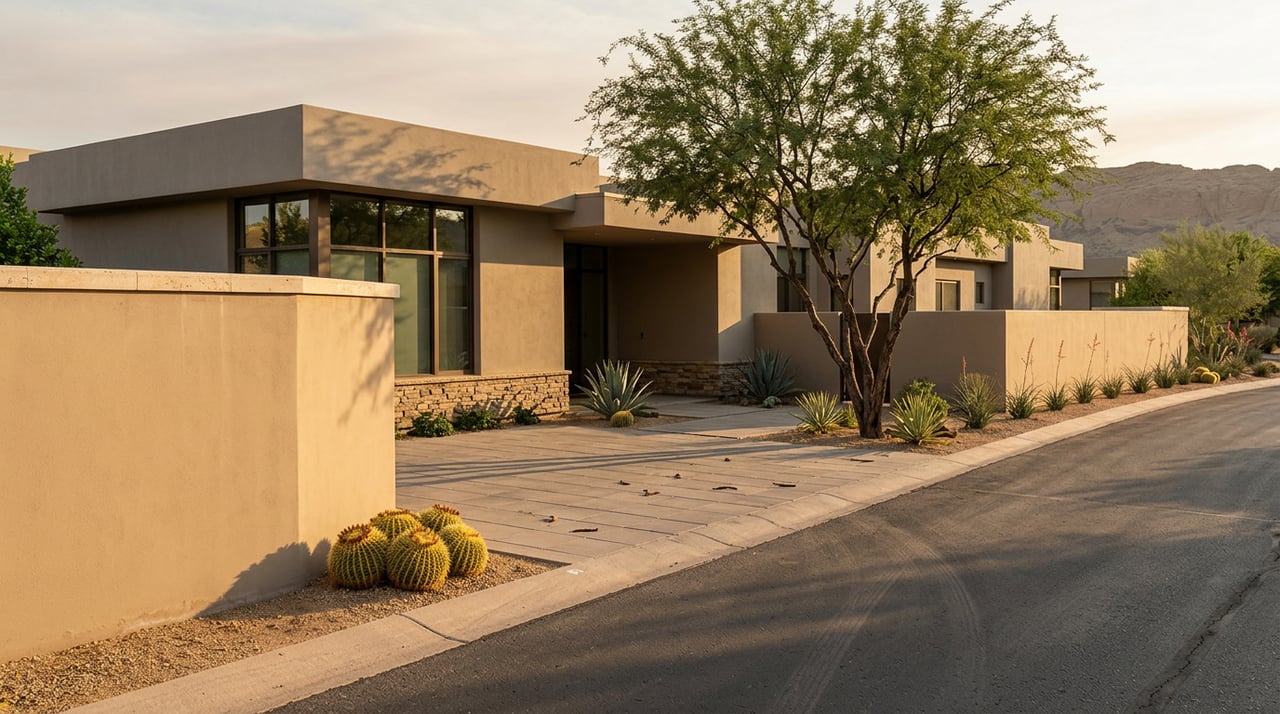
Two homes list at the same price. Same square footage, both in Summerlin, both with a Red Rock view from the primary bedroom. One sits in The Trails, planted in the mid-1990s. The other sits in Kestrel, built in 2024. On the portals they look interchangeable. On the mortgage application they are not.
The gap between them is roughly $300 a month, and none of it shows up in the list price. It lives in three fee layers that most out-of-state buyers do not model until escrow: the Summerlin master association, the village sub-HOA, and the Special Improvement District bond attached to the parcel. Those layers behave inversely to home age, which is the mechanism that reframes the whole village-shopping exercise.
The friction that surfaces in escrow, not on Redfin
The most expensive surprise in a Summerlin transaction is not the inspection report. It is the SID line on the Clark County tax bill. Special Improvement District assessments in newer sections of Summerlin can run over $2,500 a year, while older parts of the master plan have seen assessments as low as $300 or fully paid off. That range is not a rounding error. On a 20 year bond schedule it is the difference between a $6,000 lifetime obligation and a $50,000 one, and the balance transfers with the parcel automatically because it is a government-level lien, not an HOA fee.
Add the 2026 master increase. Effective January 1, 2026, Summerlin North rose to $74 per month, Summerlin South to $76, and Summerlin West to $69, according to reporting on the master board's budget. Layer the village sub-HOA on top, which runs roughly $50 to $350 per month depending on gate status and shared amenities, and the fixed monthly nut before principal, interest, taxes, and insurance can span from about $110 in an older non-gated village to more than $650 in a guard-gated newer enclave.
Here is what the same $700,000 price tag can look like across three plausible parcels:
| Village example | Master HOA (2026) | Sub-HOA range | Active SID (annualized monthly) | Fixed monthly floor |
|---|---|---|---|---|
| The Trails (mid-90s, north) | $74 | $50–$90 | Often $0, bond retired | ~$135–$175 |
| Redpoint Square (2020s, west) | $69 | $100–$200 | ~$150–$230 | ~$320–$500 |
| Stonebridge ridge lot (2020s, west) | $69 | $120–$250 | ~$180–$280 | ~$370–$600 |
Same list price. Different mortgages, different debt-to-income ratios, different offer ceilings. That is the number the median hides.
Why the newest villages carry the highest fixed costs
The mechanism is straightforward once you see it. When Howard Hughes opens a new village, the county forms a district, bonds are issued to build the streets, storm drains, streetlights, and landscaped medians, and the debt is apportioned across the parcels on a per-acre basis. The homeowner inherits an amortization schedule that runs 10 to 20 years. Once the underlying bond matures, the assessment disappears entirely and the annual tax bill drops.
That is why The Trails, The Pueblo, and other 1990s villages often show a clean tax bill with no SID line, while Kestrel, Redpoint, Stonebridge, and Reverence carry the freshest bonds in the master plan. The infrastructure that made those new streets possible is exactly what the buyer is paying off.
New construction in a master-planned community is not a premium over resale. It is a premium plus a bond. The bond is the part that survives closing.
Two other wrinkles matter. First, bonds carry interest rates set at issuance, and industry reporting places typical Summerlin and Skye Canyon bond coupons in the 4 to 7 percent range. That interest is baked into every semi-annual payment. Second, some Summerlin SIDs include escalator clauses with scheduled 2 to 4 percent annual increases, so the number on the current tax bill is not necessarily the number in year seven.
Reading the village ladder through carrying cost, not sticker
Once the fee layers are visible, the shopping map redraws itself. Rough sketch by village status:
- Bonds retired or near retirement: The Trails, The Pueblo, parts of The Arbors and The Vistas, and much of Sun City Summerlin. Lower fixed floor, older housing stock, mature landscaping.
- Active mid-life bonds: The Paseos, The Mesa, The Hills South. Bonds still amortizing, moderate assessments, established sub-HOAs.
- Freshest bonds, highest fixed floor: Kestrel, Kestrel Commons, Redpoint, Redpoint Square, Stonebridge, Reverence, and the emerging Grand Park. Newest infrastructure, highest SID balances, highest sub-HOA layers because reserves are still being built.
- Guard-gated luxury with a third layer: The Ridges and Ascension at The Peaks, where security staffing, private clubhouses, and resort amenities can push the combined association load past $900 a month before any SID is counted.
A buyer choosing between a resale in The Mesa at $720,000 and a new build in Redpoint at $710,000 is not looking at a $10,000 decision. Once the SID balance and the sub-HOA delta are annualized over a five-year hold, the comparison often inverts.
The transaction levers most buyers do not know they have
The SID balance is negotiable in structure, not in existence. Nevada Revised Statutes Chapter 271 governs the district, but how the balance moves through a specific sale is a negotiation between buyer and seller. Four common structures, in the order they typically come up:
- Seller payoff at closing. Cleanest option. The seller requests an official payoff demand from Assessment Management Group at 702-796-0082, wires the balance through escrow, and the buyer takes title with the lien extinguished. Reduces seller net by the payoff amount. Watch the prepayment penalty, which is a 3 percent to 0 percent declining schedule tied to bond term.
- Buyer assumes the schedule. No payoff, no penalty, no impact on seller net. The buyer inherits the semi-annual bill. Lender must sign off on the assumed obligation because it counts against qualifying ratios.
- Seller credit sized to a partial offset. A practical middle when prepayment windows are closed or the penalty is punitive. The credit is negotiated as a specific dollar figure at closing, applied to buyer costs, and the assessment continues.
- Purchase price reduction reflecting the balance. Cleanest for a lender that will not allow large seller credits. Price drops by the negotiated offset, buyer takes the assessment, monthly qualification math still absorbs the payment.
None of these are automatic. All four require the payoff letter in hand before the offer is finalized, and none of them work if the buyer's lender has not modeled the assessment against debt-to-income before underwriting.
The qualification math nobody warns California buyers about
Roughly a quarter of Summerlin buyers are relocating from California and using coastal equity, per reporting from Las Vegas REALTORS on the origin of recent transactions. That equity often makes the purchase price feel non-binding. The monthly qualification math is not so forgiving.
Every dollar of master HOA, sub-HOA, and SID payment counts against debt-to-income. A $2,400 annual SID plus a $200 sub-HOA plus the $69 master fee is roughly $470 a month in fixed obligations that a lender treats identically to a car payment. On a jumbo scenario with a 43 percent DTI cap, that $470 removes about $95,000 of borrowing capacity at current 30-year rates. The buyer either brings more cash, buys a smaller home, or looks at a village where the SID is retired.
That is the piece that flips the shopping list. A relocator arriving with a $1.4M pre-approval and a fixation on new construction often ends up with a $1.15M effective ceiling once the Summerlin West fee stack is modeled correctly. In an older village with no active SID, the same pre-approval buys closer to the original number.
The read for a serious Summerlin buyer
The Summerlin median moved to $695,000 over the three months ending in June 2026 per Redfin data, up 9.3 percent year over year. That number is useful for headlines and misleading for shopping. Summerlin North's three-month median sat at $514,000 through May 2026, while Summerlin West posted $805,000 in March 2026 on longer days-on-market. Those two sub-medians describe two different products carrying two different fee structures, not a single market moving in unison.
The practical move is to price homes by total monthly carrying cost rather than list price during the shortlist phase. Pull the SID balance from the tax parcel record before the second showing, model the payoff schedule against your hold horizon, and ask your lender to run the qualification math with and without the assessment. The house that wins on the portal is not always the house that wins on the closing statement.
FAQ
Does paying off the SID at closing raise the resale value of the home? Marketing a home as SID-paid is a genuine advantage in a competitive listing environment because it lowers the next buyer's fixed monthly cost. Whether the payoff recovers dollar-for-dollar at resale depends on the remaining bond term at the time of sale and how much of the interest schedule is left.
Are Summerlin SID assessments protected by Nevada's 3 percent property tax cap? No. The SID line is a bond assessment, not a property tax in the statutory sense that triggers the cap. It can move with debt service requirements, refinancings, or scheduled escalators written into the bond documents.
Does Nevada Assembly Bill 540 change any of this? AB540 allocated $50 million in relief targeted at SID and LID burdens, but relief timelines vary by district and the mechanics of how a specific Summerlin parcel benefits are not automatic. Confirm your parcel's status with the district administrator before assuming a reduction.
How do I find the SID balance on a specific parcel before writing an offer? Assessment Management Group at 702-796-0082 administers Summerlin's SIDs and issues official payoff demands. Your title officer or escrow can request the letter as part of the preliminary title package.
The village you choose in Summerlin is a fee structure as much as it is an address. If you want that math run against your specific pre-approval and a shortlist of parcels before you write an offer, Todd Beeten and the Beeten Realty Group team will pull the SID balances, model the carrying cost, and tell you which village actually clears your budget. Schedule a Free Consultation.